
Watch the waves — safely
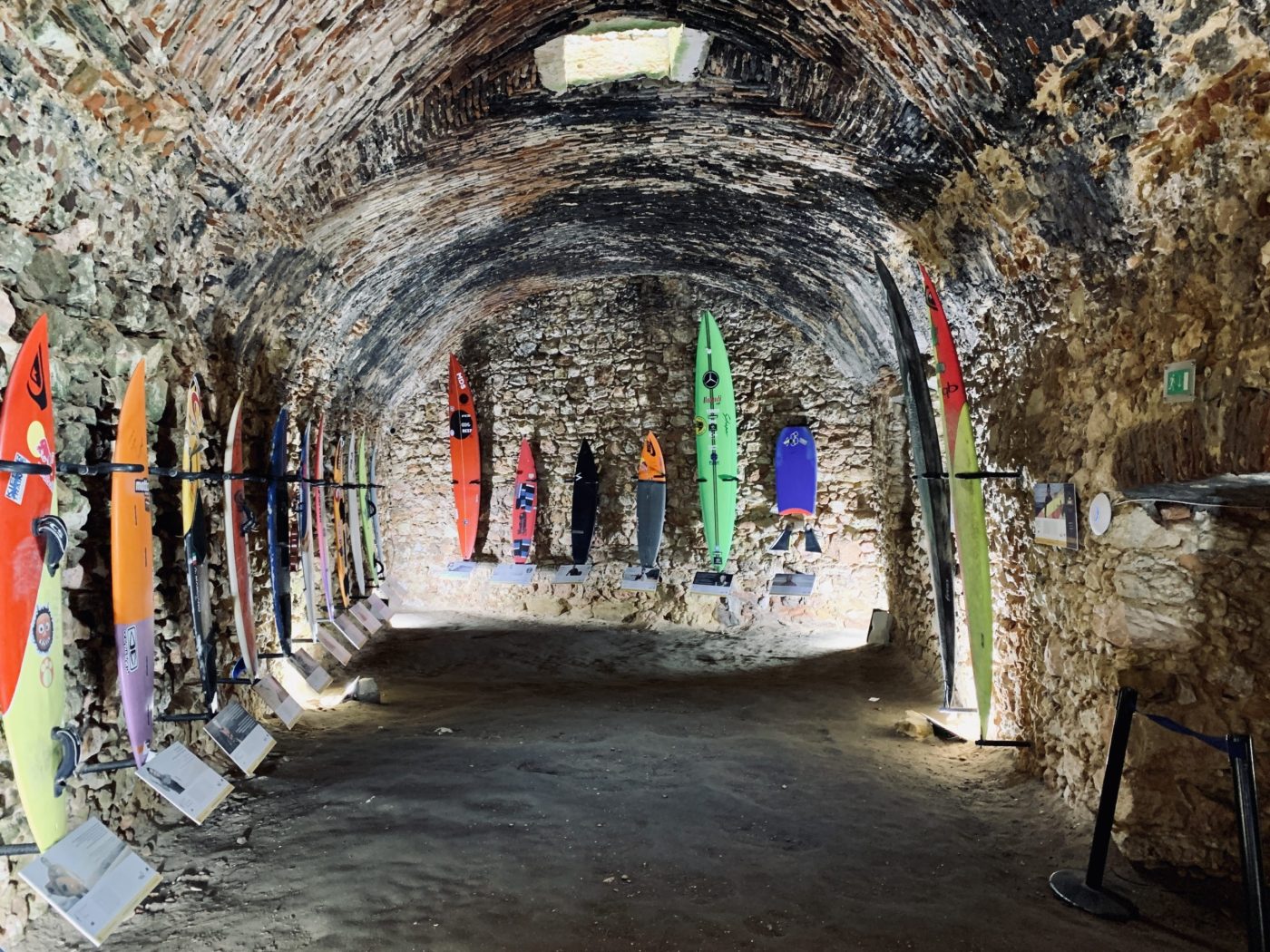
The headland fort, Forte de São Miguel Arcanjo, holds the red Farol da Nazaré lighthouse — the prime viewing point for the famous waves. It doubles as a small surf and maritime museum (about €2 admission) telling the story of the record rides at Praia do Norte, whose underwater canyon has produced the biggest waves ever surfed. Watch from the top; never climb down onto the rocks — the sea here is deadly, and every winter the swell reaches places that look safe until a set arrives.
From the fort walls you look straight down the line the surfers ride: the wave stands up as it feels the canyon, then peels toward the harbour wall while jet-skis dart in and out. If you want to understand why the water behaves like this, our Nazaré canyon guide explains the geology in plain language, and the forecast and the live webcam tell you whether the giants are running today. The big-wave season runs roughly from late autumn into early spring; on a calm summer afternoon the same headland is simply a beautiful clifftop walk.
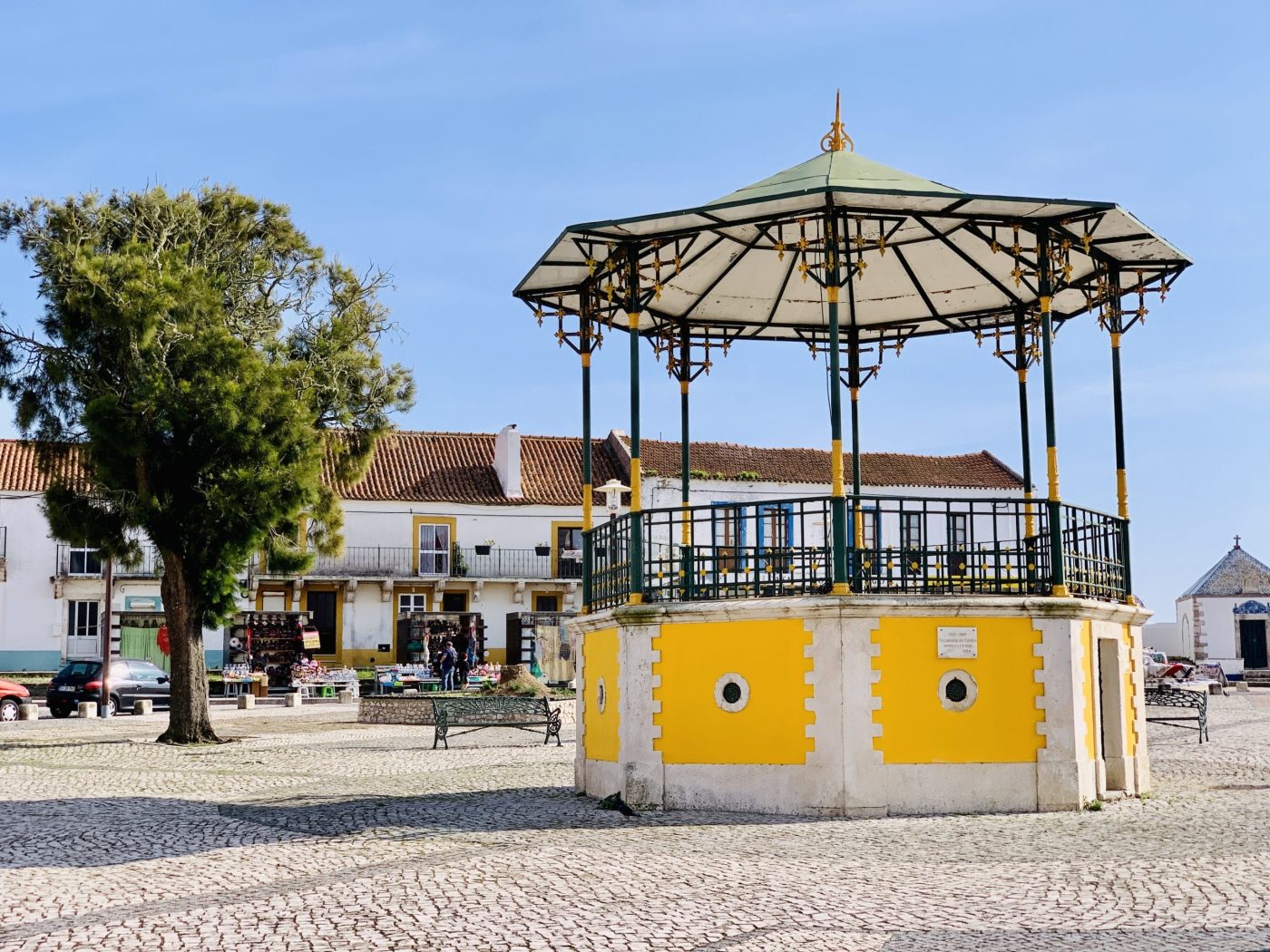
Up in Sítio
The Ascensor da Nazaré, a steel funicular running for more than 130 years, climbs the roughly 380 m from the beachfront up to the clifftop district of Sítio — €1.50 one-way, €2.90 return. The ride itself is part of the fun, rattling up the slope with the whole bay opening behind you; the old carriages are a small piece of history in their own right.
At the top, the Miradouro do Suberco sits about 110 m above the sea, a low wall between you and a sweeping view over the golden crescent of beach, the red-roofed town and the surf breaking far below. It is the postcard shot of Nazaré, and it is free. A few steps away stands the 14th-century Sanctuary of Our Lady of Nazaré, its plain facade hiding a golden Baroque interior and a small, dark wooden Madonna that has drawn pilgrims for centuries — the town’s great pilgrimage and festival in her honour falls in September.
Close by is the tiny Ermida da Memória, a little chapel lined with blue-and-white azulejos, built on the very spot where the town’s founding legend unfolds. For a quieter view, walk out to the Miradouro da Pederneira over the orange rooftops of the oldest part of Nazaré — often empty while the crowds gather at Suberco.
The legend of Nazaré
The Ermida da Memória exists because of a story every local knows — O Milagre da Nazaré, the Miracle of Nazaré. In 1182, the knight Dom Fuas Roupinho was hunting a deer along the cliffs in thick morning fog. The animal ran toward the edge and he galloped after it, unable to see the drop ahead. At the last instant he cried out to the Virgin, and his horse stopped dead at the very lip of the precipice, hooves at the edge of the void.
Believing the Madonna had saved his life, Dom Fuas ordered a chapel raised on the spot: the Ermida da Memória, the “chapel of remembrance”. The miracle gave the settlement its identity as a place of pilgrimage, and knowing the legend changes how the clifftop feels — that low wall at Suberco is the edge the horse refused, and the whole of Sítio grew up around a single moment of fog and faith.
Down in town
The long golden Praia da Nazaré, the lively Mercado Municipal and the seafront tavernas are the heart of town. In summer the beach fills with umbrellas and the promenade stays busy late; out of season it belongs to the fishermen and the gulls. Wander the market in the morning, when the day’s catch is laid out on ice.
This is still a real fishing community, not a stage set. Look out for the older women in the traditional seven skirts — the sete saias — and for the racks of fish drying in the sun on the sand, a preservation method that predates refrigeration and still flavours local kitchens. It is worth pausing to remember that the town lived from this sea long before anyone came to watch it break. If you are planning where to base yourself, our stays guide covers the difference between the beachfront, Sítio and the quieter edges of town.
Where and what to eat
Nazaré eats what it lands. The classic dish is caldeirada, a slow fish-and-shellfish stew that changes with the catch; alongside it you will find grilled sardines in summer, percebes (goose barnacles) prised from the rocks, and açorda, a garlicky bread-and-seafood pottage. The famous sun-dried fish, peixe seco, turns up grilled as a snack and folded into heartier plates.
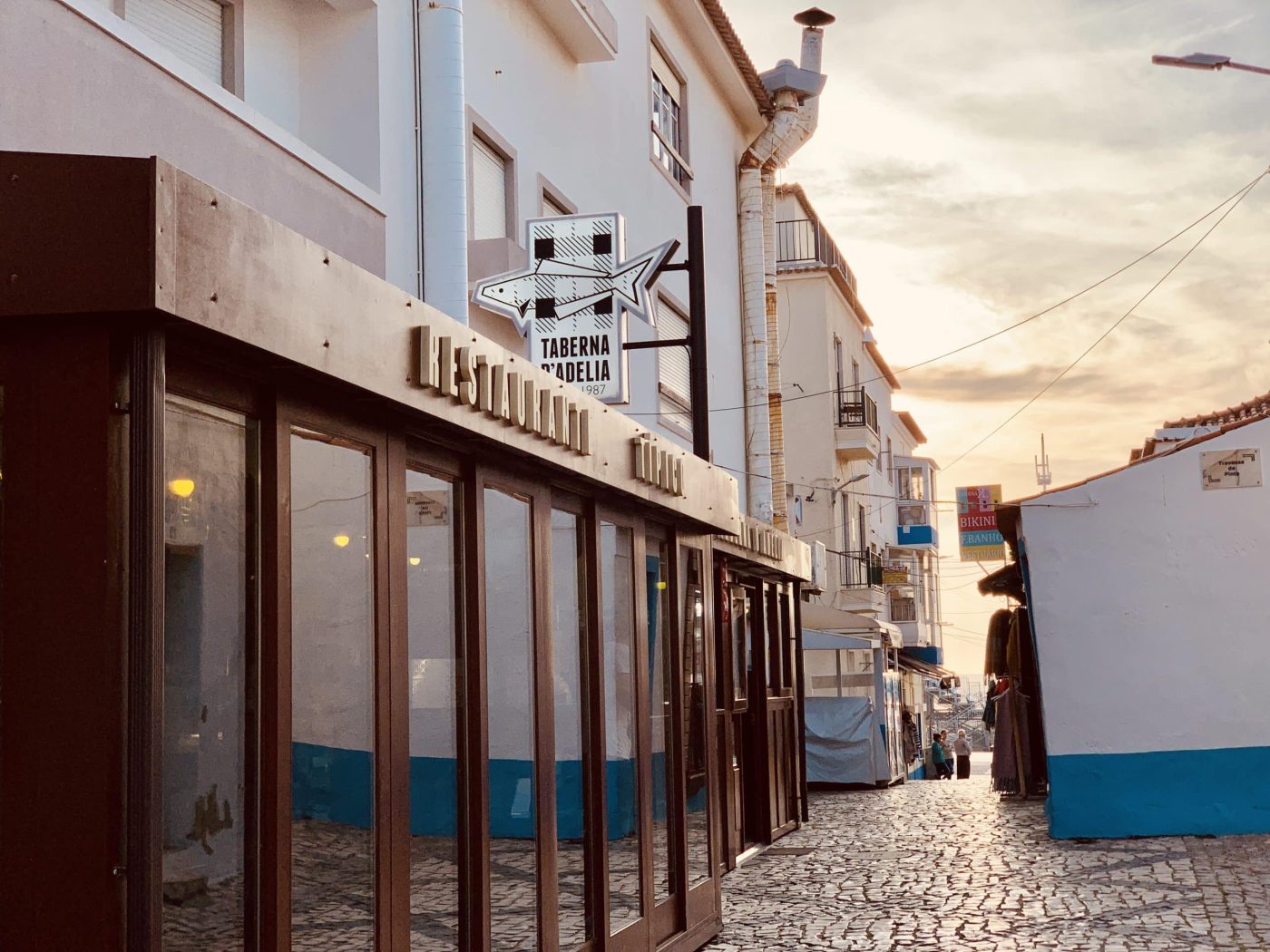
Eat where the town eats: the seafront tavernas for grilled fish, crab and clams — places like Taberna d’Adélia — or somewhere like Sitiado for more creative Portuguese small plates. The honest framing helps here: this is a working port, prices are fair, portions are generous, and the best meals are usually the simplest ones, straight off the grill.
With kids, or on a flat day
When the ocean is quiet, the giant waves are not the show. In summer the Norpark water park — slides, a semi-Olympic pool, a giant jacuzzi and a children’s area — is a good alternative, and the sheltered town beach stays calm and family-friendly while the giants roll into Praia do Norte next door.
If it is your very first visit, our first-time guide lays out a simple plan for one or two days, and the getting there page covers arriving by car or bus.
Beyond Nazaré — easy day trips
Nazaré makes a fine base for exploring central Portugal, with several classic stops within an easy drive. The walled medieval town of Óbidos, about 30 km south, is a tangle of whitewashed lanes inside its castle walls. The UNESCO-listed Monastery of Alcobaça, a short drive away, holds one of the country’s greatest Gothic churches, while the Monastery of Batalha, also UNESCO-listed, is an extraordinary flamboyant-Gothic pile built to mark a medieval battle.
- São Martinho do Porto — a calm, shell-shaped bay a few kilometres south, with warm shallow water; the safe swimming counterpoint to Nazaré’s open surf.
- Fátima — the great pilgrimage town, roughly 45 minutes inland, one of the most important Catholic sites in the world.
- Caldas da Rainha — a spa town known for its daily fruit-and-vegetable market and its playful ceramics.
With a car you can string two or three together in a day, which makes Nazaré a fine base for several nights rather than a single stop. Whatever you plan, check the forecast before you commit a day to the coast — and if the giants are running at Praia do Norte, everything else can wait.